Share
Update on Ontario Line construction at Pape Station
Controlling impacts while driving progress at a critical subway connection
Mar 12, 2026
The Ontario Line will bring more transit service to Pape Station in the city’s east end, making it easier to travel from Greektown to Liberty Village to Flemingdon Park and beyond.
We know that building a subway line can affect how people live, work and move through the area during construction. That’s why we’ve put measures in place to help manage and reduce these impacts where possible.
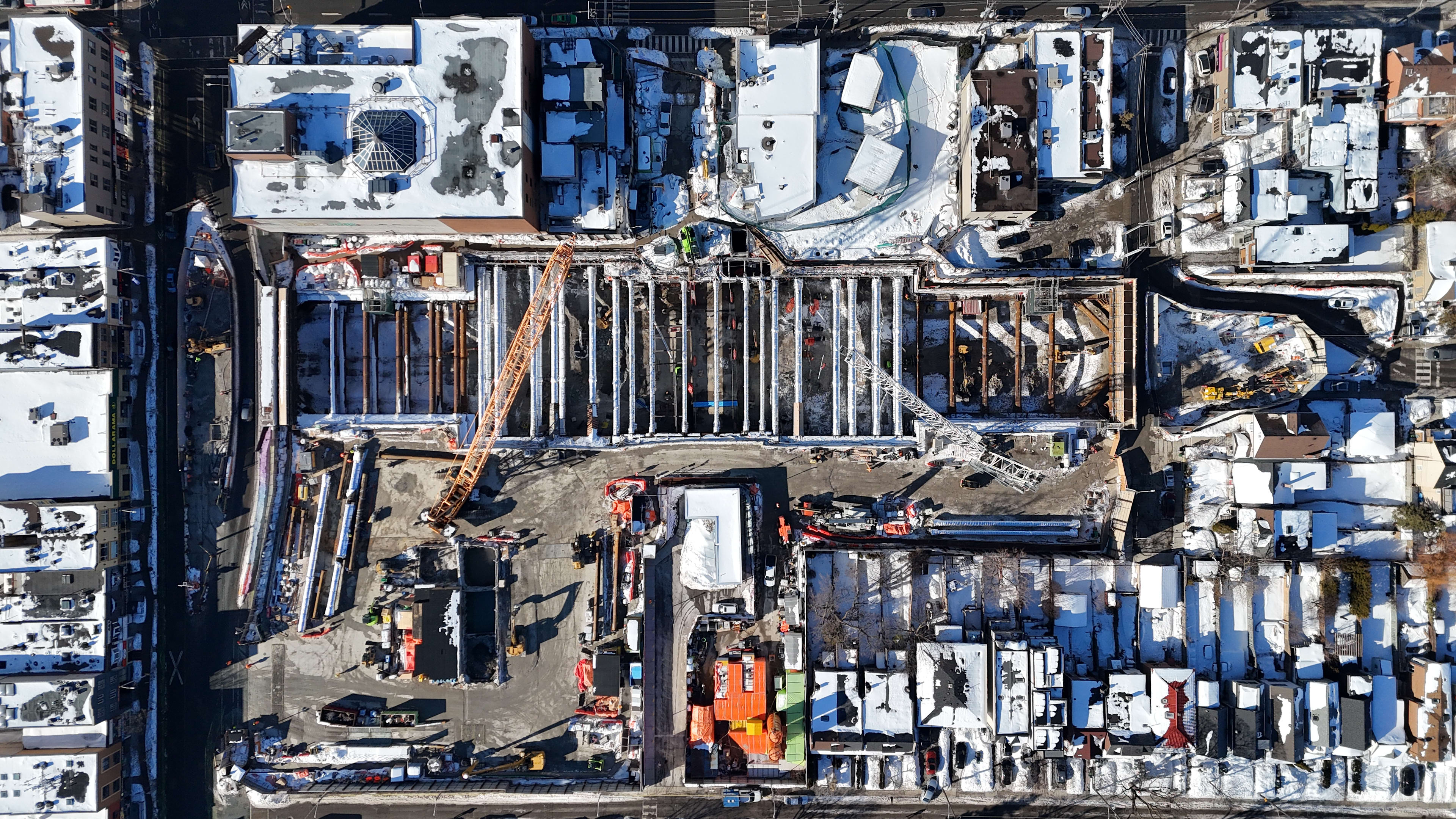
To date, we have made major progress on this important new connection to TTC Line 2 at Pape and Danforth. The work site is bounded roughly by Pape, Danforth, Eaton and Lipton avenues, with a portion of the site extending up to Gertrude Place behind the existing station.
Maintaining pathways

An aerial view of the Ontario Line construction site at Pape Station. (Metrolinx image)
Since work started at the site in early 2024, we have maintained a designated pathway for cyclists on the north side of the Danforth from Pape to east of Eaton. The bike path is bright green to ensure visibility and barricades are in place to enhance safety.

The bike lane on Danforth Avenue is painted and barricaded for enhanced visibility and safety. (Metrolinx image)
Clear directional signage also guides pedestrians who must cross to the south sidewalk to travel east or west along this stretch of the Danforth. We added a temporary crosswalk at Danforth and Eaton avenues to help pedestrians navigate safely and more easily throughout the area while the north sidewalk remains closed during construction.
Managing around-the-clock station excavation
We recently entered another major phase of construction at the site with the beginning of excavation. During this stage, we are first digging down to the existing TTC station to expose it and reinforce its foundations in a process known as “underpinning.” After that, we will continue excavating below it to create an underground cavern for the future Ontario Line station and tunnels. Once the cavern is dug out, we will set up a safe, functional, full-scale construction site underground.

Supports – known as bracing or struts – are installed to reinforce the walls around the excavated area. (Metrolinx image)
Digging around and beneath an active subway station requires an even higher degree of precision than regular excavation work. We need to work around the clock at Pape Station because other key parts of the project can’t start until excavation and underground cavern work is completed.
To help manage noise and vibration levels at all times of the day, we have monitors in place to alert us to excessive noise so we can adjust work when needed. At Pape, we have equipped trucks with modern broadband backup alarms, which emit a less alarming sound compared to traditional backup beeping. Whenever possible, we prioritize forward truck movements in and around our sites to increase safety and avoid the need for backup alarms when reversing.
We also added new noise walls and raised existing ones where possible. We plan to extend noise walls along Gertrude Place later this year, and we will continue to look for opportunities to safely add or raise barriers as work progresses.
Dust and mud controls
Construction can also stir up dust and move mud around. Keeping our work areas tidy and reducing the amount of dust and mud that travels outside our site is a priority for us as good neighbours in the communities where we build.
We work closely with the City of Toronto and private partners to clean public spaces outside of construction sites, including street sweeping and, on occasion, window washing. Street cleaning and window washing activities typically take place during warmer months, and snow clearing around sites is a top priority during winter.
We also regularly water down the soil on our site to prevent dust from migrating beyond the fencing. To manage mud, we have installed mud mats and a wheel washing station to clean tires before trucks exit the Pape site.

A wheel washing station is installed at the Danforth Avenue gate on the Pape site. (Metrolinx image)
Truck safety
Trucks play a key role in supporting the construction activities needed to build more transit – from delivering materials and equipment to the site to hauling excavated soil away from it. Truck safety is top of mind across the project as construction-related traffic increases.
To help people navigate safely around our sites, we station traffic control personnel at high traffic spots like construction gates. Traffic control personnel can include either construction crew, known as “flag persons,” or paid duty officers from the Toronto Police Service.
Recognizing the complexity and scale associated with the Ontario Line – and the volume of trucks in the city – we have taken the additional step of formalizing a Truck Safety Plan. We have standard requirements and enforcement measures in the plan to help manage the increased truck traffic during Ontario Line construction.
Determining the best possible truck routes is a key measure we take to minimize impacts to the community, including using routes that prioritize main roads and quickly get trucks out of the city and onto highways as much as possible. Once finalized, we publicly post maps of the designated truck routes for Ontario Line construction sites in the appendix of the Truck Safety Plan.
All drivers working regularly on the Ontario Line must complete route familiarization training before beginning any work, including signing an acknowledgement form to confirm they are aware of the rules and consequences for non-compliance. In addition to this onboarding, contractors are required to deliver ongoing education through regular briefings and driver information sessions.

Crew reviewing the designated truck route at the Pape Station site. (Metrolinx image)
To help ensure drivers follow the designated routes in the area, we are working with contractors to add signage to Ontario Line trucks and install GPS tracking across the fleet early this year. GPS tracking is already installed on trucks servicing Pape Station, and signage identifying Ontario Line-related trucks will be installed on trucks in this area first.
What’s next
After excavation and cavern preparation, the site will be ready for tunnel boring machines to pass through on their journey to dig out twin subway tunnels along Pape Avenue. Tunnelling will mark the next major phase of construction on the station.
To help keep the community updated on ongoing and upcoming work, we have a dedicated construction liaison committee (CLC) for the Pape-Danforth & Sammon area. The CLC meets regularly to provide updates and hear directly from local residents, businesses and community leaders. CLC meetings include a mix of virtual sessions and in-person community walks. We encourage anyone interested in joining the CLC to contact us.
When complete, the new Ontario Line connection to Pape Station will serve over 10,000 customers during morning rush hour. More than 9,000 of those riders will use the station to transfer between the Ontario Line and other transit services like the Line 2 subway and local bus routes.

Artistic rendering of the future Ontario Line Pape Station entrance on the north side of Danforth Avenue, east of Pape Avenue. (Metrolinx image)
For more updates on Ontario Line progress, follow @OntarioLine, sign up for our newsletter or connect with us in person at a community office