Share
Safety is built into the Finch West LRT
What to know about the safety features of Line 6 Finch West’s vehicles, stations and stops.
Dec 8, 2025
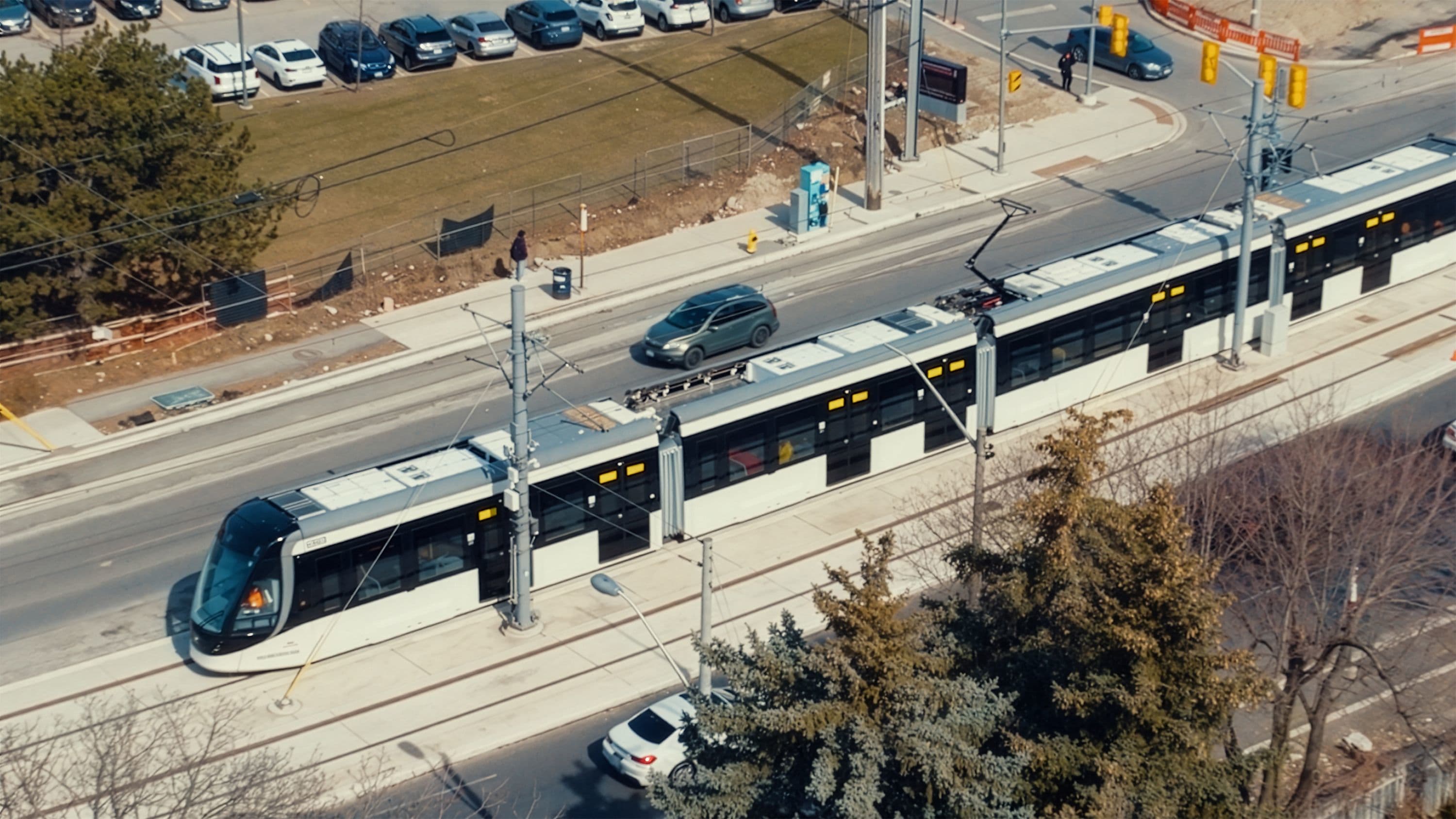
Line 6 Finch West (Finch West LRT) runs along Finch Avenue West from Keele Street to Highway 27, where it turns and travels south to the Humber Polytechnic North Campus. With 18 stops across nearly 11 kilometres of rail, it gives residents and commuters in northwest Toronto more choices for travel, offering connections to other TTC lines as well as Peel and York Region local transit services.
The new light rail transit (LRT) line was built with safety in mind. Its light rail vehicles (LRVs), two stations and 16 stops all incorporate many important safety features designed to keep passengers, pedestrians and road users safe.
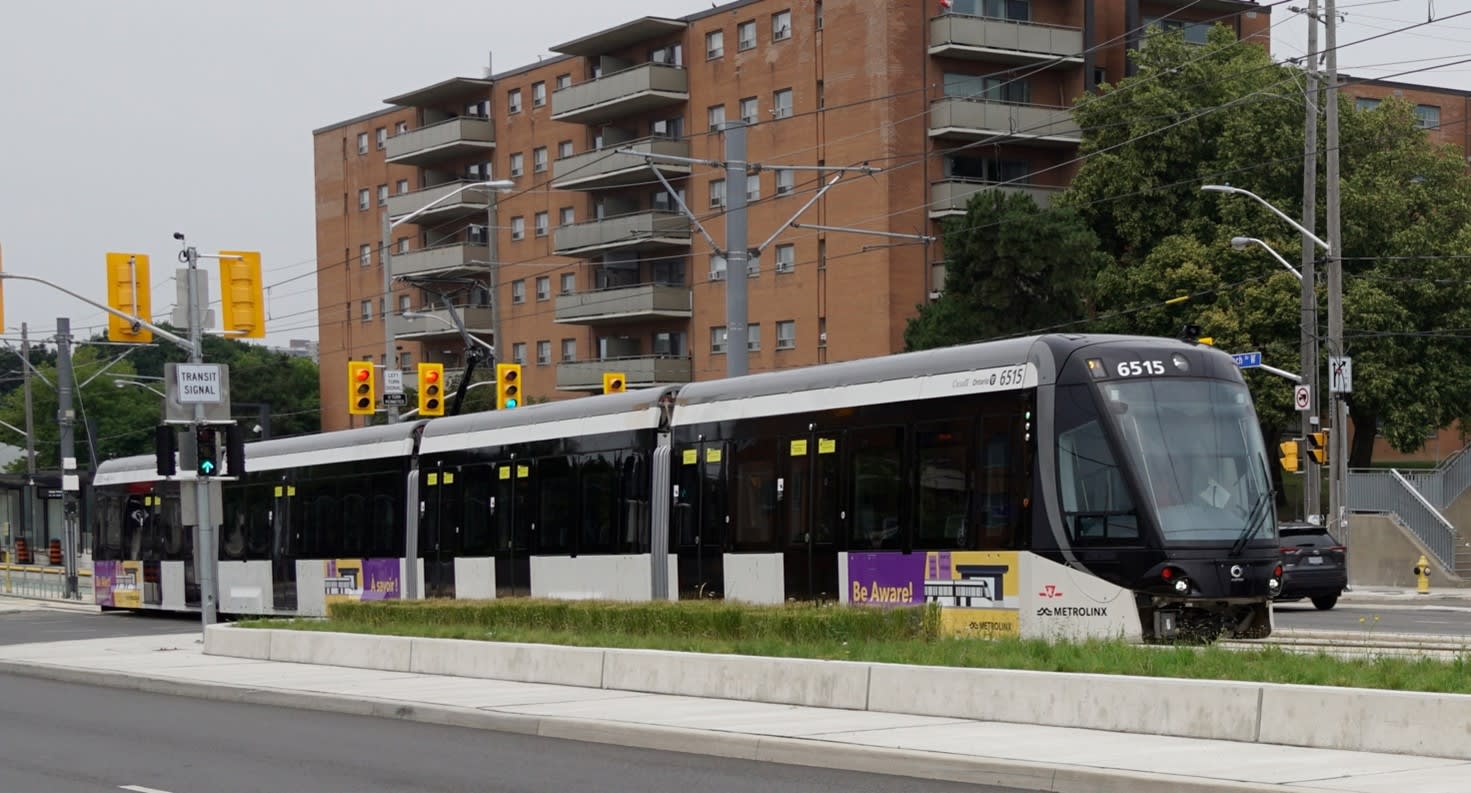
LRVs are equipped with safety devices like horns and bell chimes. (Metrolinx photo)
Light rail vehicle safety devices
LRVs contain safety devices such as horns and bell chimes to assist transit users during their commute and keep pedestrians and road users alert and safe. Operators use the horn to communicate movement: Two short blasts signal that an LRV is about to move from a stopped position or bypass a station platform. One long blast alerts pedestrians, cyclists and motorists who are trespassing on the guideway to an approaching LRV. It can also be a warning that an LRV may be operating in reverse traffic. Inside each vehicle, a bell chime with a short “doors closing” announcement indicates to passengers that the doors are closing and the LRV will be moving from the platform.
Each LRV car has a red ‘Passenger Emergency Intercom’ button, marked in braille for the visually impaired, inside by the doors. The intercom allows passengers requiring assistance to speak directly with the LRV operator. Above the button is a red emergency door pull handle, which allows passengers to manually pull the vehicle doors open and exit in case of emergency.
Safety features at stations and stops
At every station and stop along Line 6 Finch West, there are tactile walking surfaces, including the important ‘yellow line’ that indicates the edge of all platforms. Passengers should always wait behind the yellow line for an arriving LRV to come to a complete stop before approaching the edge of the platform.
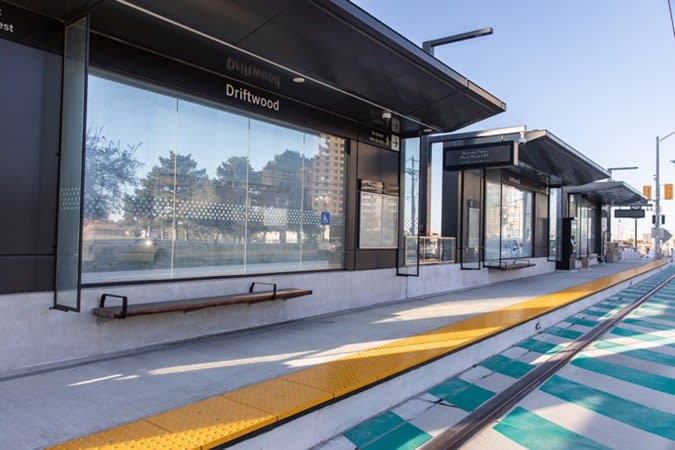
Passengers should wait behind the yellow line until the train comes to a complete stop before approaching the edge of the platform. (Metrolinx photo)
The gap between the LRV and the platform boarding edge has been carefully built to ensure a minimal gap which offers comfort and safety to riders entering or exiting the LRV. At stop platforms, passengers will find ramp access instead of stairs. And in the two stations where stairs are present, the handrails are illuminated to enhance visibility for all users in low light.
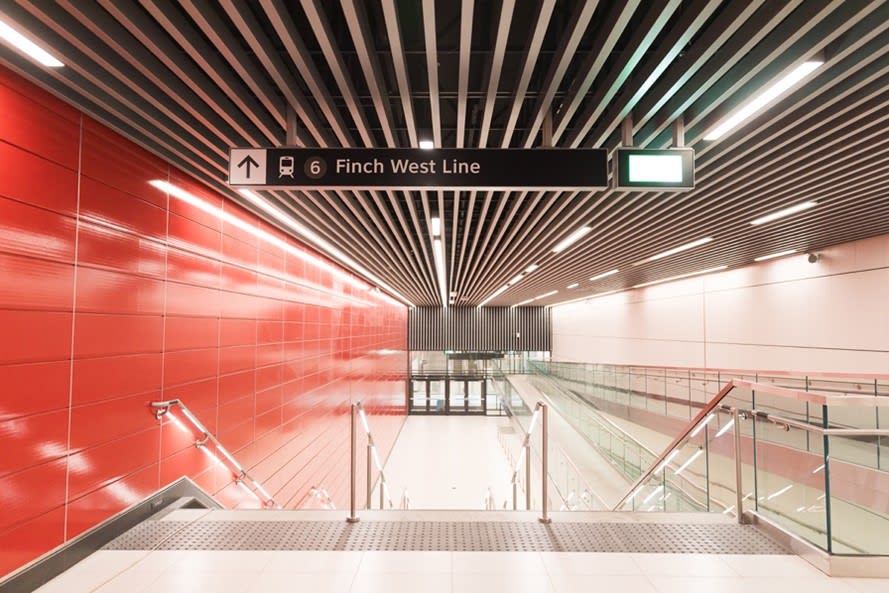
At each station, handrails are illuminated to enhance visibility for all users in low light. (Metrolinx photo)
At both stations and every stop, there are two passenger assistance intercom buttons: The blue one, marked ‘Information’, is for general assistance. The red button, marked ‘Emergency’, is for emergencies. These intercoms are connected to the Toronto Transit Commission transit control centre 24 hours a day, seven days a week. Riders are encouraged to use the intercoms if they need assistance, are feeling unsafe, or if they witness a crime or medical emergency.

At both stations and every stop, there are two passenger assistance intercom buttons. (Metrolinx photo)
There is a Public Visual Information System consisting of four screens installed at all stations and stops, in both directions. The screens display real-time estimated LRV arrival times as well as any updates or alerts that passengers should be aware of during their commute.
Protection for pedestrians and drivers
At every LRT stop along Finch Avenue West, there is a ‘pedestrian refuge’ area — a safe place for pedestrians to stay if they aren't able to cross the street before the light changes. At intersections without an LRT stop, pedestrians will need to time crossings appropriately to avoid standing on the tracks between traffic signals.
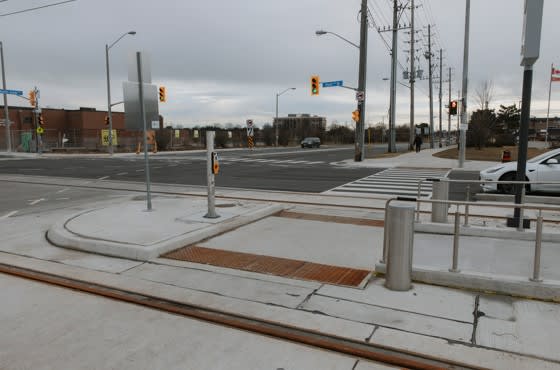
Pedestrian refuge areas are a safe place for pedestrians to stay if they aren't able to cross the street before the light changes. (Metrolinx photo)
At the portals of Humber College and Finch West stations — where trains enter and exit the underground portions of the line — is a safety system known as the Guideway Intrusion Detection System (GIDS). The GIDS uses laser scanners which are synced with light rail vehicle movement detectors to sense when people or objects enter the tracks. If a person or large object, like a car, is detected on the tracks, an automatic alarm signal is sent to the control system, and the LRV will automatically stop. The public announcement system will be automatically triggered to announce a warning to clear the tracks.
These important safety devices and features, built into the design of Line 6 Finch West’s vehicles, stations and stops, help keep passengers, pedestrians and road users alert and safe on their journey. These important safety devices and features, built into the design and operation of Line 6 Finch West’s vehicles, stations and stops, help keep passengers, pedestrians and road users alert and safe on their journey.
Learn more about safely navigating light rail transit in your community.