Share
Ontario Line crews kick off summer construction season downtown
From Exhibition to the Distillery District, Ontario Line teams will be working this summer.
Jun 26, 2026
While the kids are bursting out of classroom doors on the last days of school and diving headfirst into a summer of swimming, camp, video games and cold treats, Ontario Line construction teams across the downtown core are rolling up their sleeves for a season of progress.
This summer, from Exhibition Station in the city’s west end to the Distillery District in the east, crews will be working to bring new subway stations to life – all while twin tunnel boring machines (TBMs) Libby and Corkie carve their paths beneath the city.
Exhibition Station
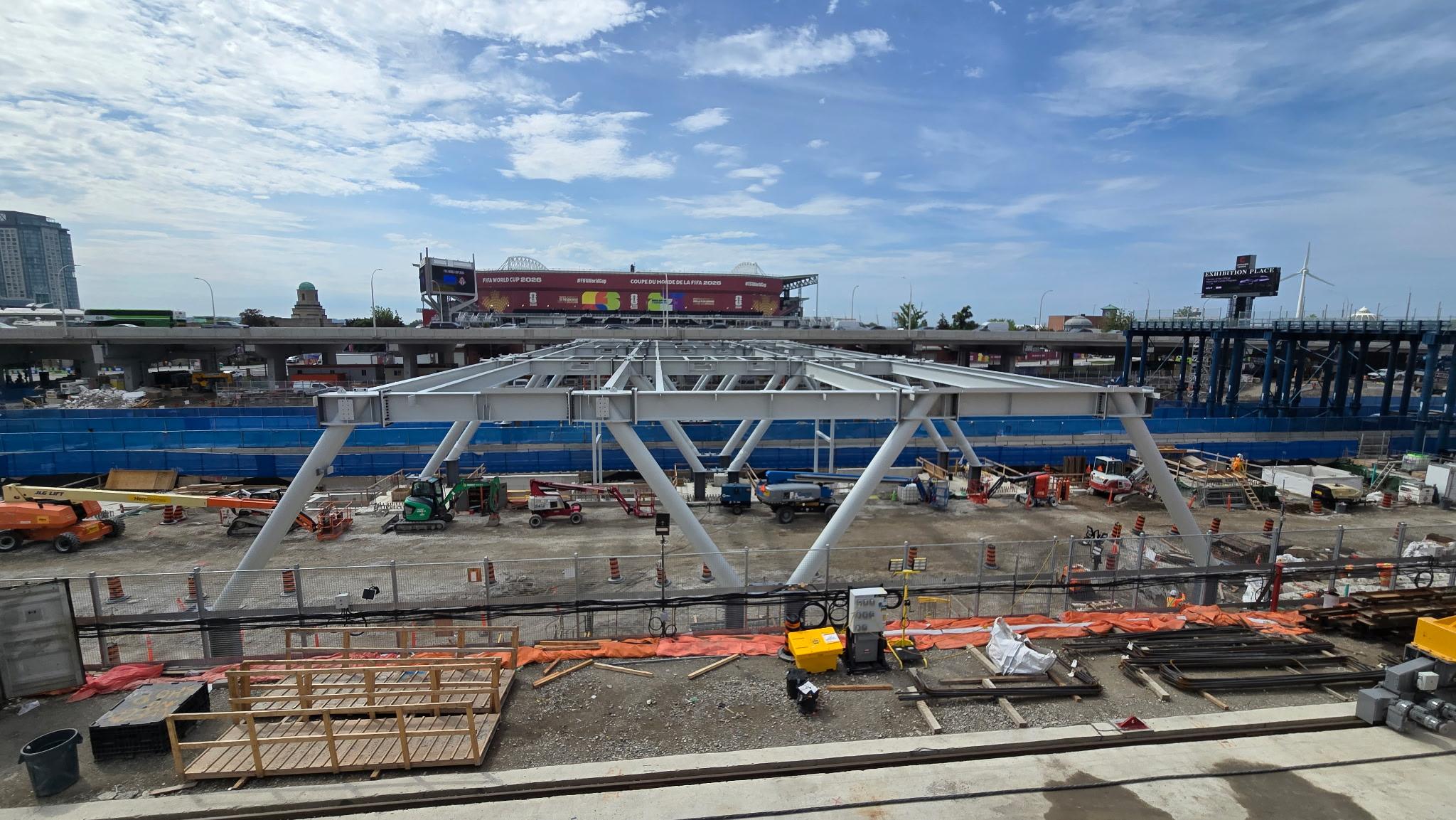
At Exhibition, crews will continue to install over 90 v-columns and connecting beams over the tracks. These steel elements will help create the skeleton of the future Exhibition Station over the GO Train tracks.
Crews will also continue to excavate new station entrances on the south side of the track as well as concrete and structural works for the main entry north of the tracks and the facility that powers the trains – the traction power substation.
Corkie – the second TBM for the downtown segment of the line – will start tunnelling alongside Libby this summer. As Libby and Corkie tunnel, they will excavate debris that will be carried by conveyors. The conveyors will carry the debris from the TBM through the sides of the tunnel and into the muck pit. The muck pit is located east of the launch shaft and where trucks will load up the rock to be hauled away.
The grout plant – also located in the east end of the Exhibition site – is where grout is mixed to support the tunnel segments installations. The TBMs inject the grout between the concrete tunnel lining segments they install during the tunnelling process.
Exhibition Station and the launch shaft are truly the heart of Ontario Line downtown construction, where workers are forming an upgraded interchange station that will seamlessly connect Ontario Line and GO train services while also supporting tunnelling operations for the entire downtown section of the project.

Steel vertical columns (v-columns) built at Exhibition Station
King West Station
Station and cavern excavation at the future King West Station has been completed for a few months. This summer, crews will continue to make the dug-out station cavern look more like a permanent subway station. They’ll be using a system called crown lining formwork, which is a large machine that can create entire segments of the subway cavern with large concrete pours. This process ensures the concrete sets properly, creating a solid structure for the walls and ceilings of the future station platform level.
Of course, King West will be the first station Libby and Corkie will break through on their journeys beneath downtown Toronto, so teams are excitedly preparing for their arrival.

Inside the cavern at King West Station showing yellow waterproofing materials
Chinatown Station
At the Chinatown Station, excavation has been completed, and crews are beginning permanent underground work at the future south entrance and station platform. Permanent work refers to the types of things teams will do to start making the excavated caverns look more like functional buildings including building walls, floors, stairs, elevators and other elements the buildings require to become your new subway station.
A new tower crane will also be installed at the south site. This new piece of machinery will help bring materials needed for the permanent station work – like waterproofing and the installation of steel rebar and other materials -- which will help bring to life a brand-new subway station at Queen Street and Spadina Avenue.

Inside the cavern at Chinatown Station
Osgoode Station
At Osgoode, crews are wrapping up station excavation on the north and south sides of the intersection at Queen Street and University Avenue, as well as the cavern deep underground. Once complete, teams will start on permanent station work, like what is underway at other stations in the downtown core.
Crews are also beginning work on vent shafts. If you live or frequent downtown Toronto, you’re likely no stranger to a vent shaft. Vents shafts are the air ducts in the sidewalk that allow air and heat to move into and out of the underground tunnels. They might seem fairly humble compared to stations, but they have a very important job for daily use as well as in emergencies.

Inside the cavern at Osgoode Station
Queen Station
Working between two busy downtown intersections – and connecting to a fully operating TTC station without disrupting service – is no easy feat. But once complete, this new subway station will become a vital transfer point for thousands of commuters.
Crews are continuing with station excavation over the summer, and vent shaft construction is also underway on James Street.

View from underneath the struts and wailers supporting excavation at Queen Station
Moss Park Station
Permanent station work has been underway at Moss Park Station for a few months, with steady progress taking shape below ground. Teams will continue installing structural elements that will become the future station’s skeleton, providing stability and strength to the building. They will also carry out waterproofing, steel, electrical, plumbing and concrete works.
On the topic of concrete, crews expect to complete the concrete pours for the concourse and platform levels this summer, marking a significant step toward bringing the station to life. These new surfaces will eventually become the concourse and platform levels that future riders will navigate and stand on while waiting for their Ontario Line train.

Poured concrete at Moss Park Station
Distillery District Station
Permanent station work is also well underway at Distillery District Station, with teams focusing on waterproofing, installing rebar, and concrete pouring. This site also plays a key role for the entire project, as it is home to the architectural mockup building.
Currently under construction, the mockup building is a temporary structure that will act as a model for materials and finishes that will be used for the future Ontario Line stations across the route. It will give project teams the ability to assess them in a real-world setting, helping ensure quality, functionality and consistency for the final station buildings and infrastructure. Once Ontario Line construction is complete, the mockup building’s job will also be complete, and it will be removed from the site.

Temporary mock-up building under construction at Distillery District Station
Stay informed
Planned construction activities are always shared ahead of their expected start date. Digital construction notices for Ontario Line work can be found at Metrolinx.com/OntarioLineConstruction.
To see more signs of progress throughout the summer and beyond, be sure to follow us on our socials: