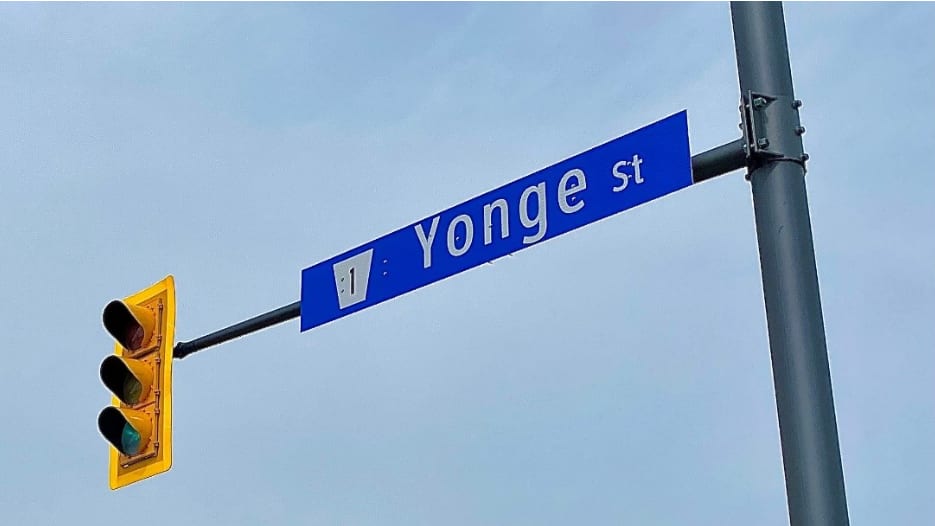
What to expect as work begins near Yonge Street and John Street
Traffic changes and road work pave the way for Yonge North Subway Extension construction.
Jun 26, 2026
New traffic changes and construction work have begun in the area of Yonge Street and John Street in York Region.
The changes will support construction of the Yonge North Subway Extension – a project that will bring TTC Line 1 service approximately eight kilometres farther north, with five new stations in Toronto, Vaughan, Markham and Richmond Hill.

Road work and traffic changes will support construction of the Yonge North Subway Extension while keeping the community moving.
The first steps include removing the centre median on Yonge Street, installing temporary concrete barriers and moving traffic signal lights from roadside poles to overhead wires spanning the roadway.

The approximate work zone along Yonge Street is represented by the yellow shaded area.
As work moves forward, you will notice lane reductions and turn restrictions near the intersection with John Street to accommodate widening Yonge Street on the east side of the roadway. This will create space for future construction while keeping traffic flowing safely through the area.
What to expect
Pedestrians and transit users will see some temporary changes.
Bus stops will be relocated and the sidewalk on the east side of Yonge Street will be shifted while pavement, curbs and vegetation are removed. You may also notice temporary construction areas as existing utilities are relocated.
Safety barriers, signage and temporary pedestrian routes will be installed to help make sure people are able to move through the area.
What’s all this work for?
These temporary changes are needed to accommodate construction of an emergency exit building (EEB) that will connect to the future subway tunnels.
These buildings are a standard feature of modern underground transit lines and provide a safe way for passengers and first responders to enter or exit the tunnels in the unlikely event of an emergency.
Once the site is prepared for construction, excavation will begin to create a shaft that will connect to the future subway tunnels. Construction of the EEB will follow.
Overall, work to build the emergency exit building will take place over several years, meaning construction zones will remain in place for an extended period.
As plans are finalized and work moves forward, Metrolinx will continue to share updates and advance notice of significant construction activities and traffic changes.
Keeping the community moving during construction
Temporary changes like these are a common part of building large transit projects like the Yonge North Subway Extension.
Before work begins, Metrolinx works with municipal and regional partners to develop traffic management plans that consider local traffic patterns, nearby businesses, schools, existing transit services and the unique conditions of the surrounding area.
Learn more about how Metrolinx manages traffic and keeps communities safe during construction of important transit improvements.