
Tracking Ontario Line construction in the east end
Progress is rolling alongside existing train tracks to build the new subway line in Toronto.- Projects & Programs
- Ontario Line
- Tracking Ontario Line construction in the east end
Share
Throughout Riverdale, Riverside and Leslieville, Ontario Line trains will run on their own dedicated tracks next to GO Transit and VIA Rail trains.
Three new stations will serve Ontario Line customers in these neighbourhoods: East Harbour, Leslieville and Gerrard. Before work could begin on the stations, we first needed to make early upgrades to the existing rail line and surrounding infrastructure to prepare for the stations.
Early rail upgrades
Early upgrades along the rail line included relocating utilities, shifting approximately six kilometres of GO train tracks and demolishing and rebuilding four existing rail bridges at Eastern Avenue, Queen Street East, Dundas Street East and Logan Avenue. To complete the work while keeping Lakeshore East GO trains running, crews rebuilt each bridge one half at a time.

New rail bridge spanning Queen Street East at De Grassi Street, looking east. (Metrolinx image)
The new rail bridges will accommodate six tracks — four for GO trains and two for the Ontario Line, versus only three previously — which will allow for more transit service in the future. They also replace bridges that were more than 100 years old and provide more clearance for vehicles underneath.
Meet Ontario Line's new and expanded rail bridges
Since finishing the bridges in June, crews have been wrapping up the last of the upgrades, including installing permanent lighting, connecting utilities and restoring the roads.
Designed for the community
Finishing work on the rail bridge at Queen Street East and De Grassi Street created space for a new landmark mural in the Riverside community, developed in collaboration with the Riverside BIA and the City of Toronto. The new mural, called “River of Life,” was designed and installed by Indigenous artist Que Rock to bring new life to the space beneath the bridge.
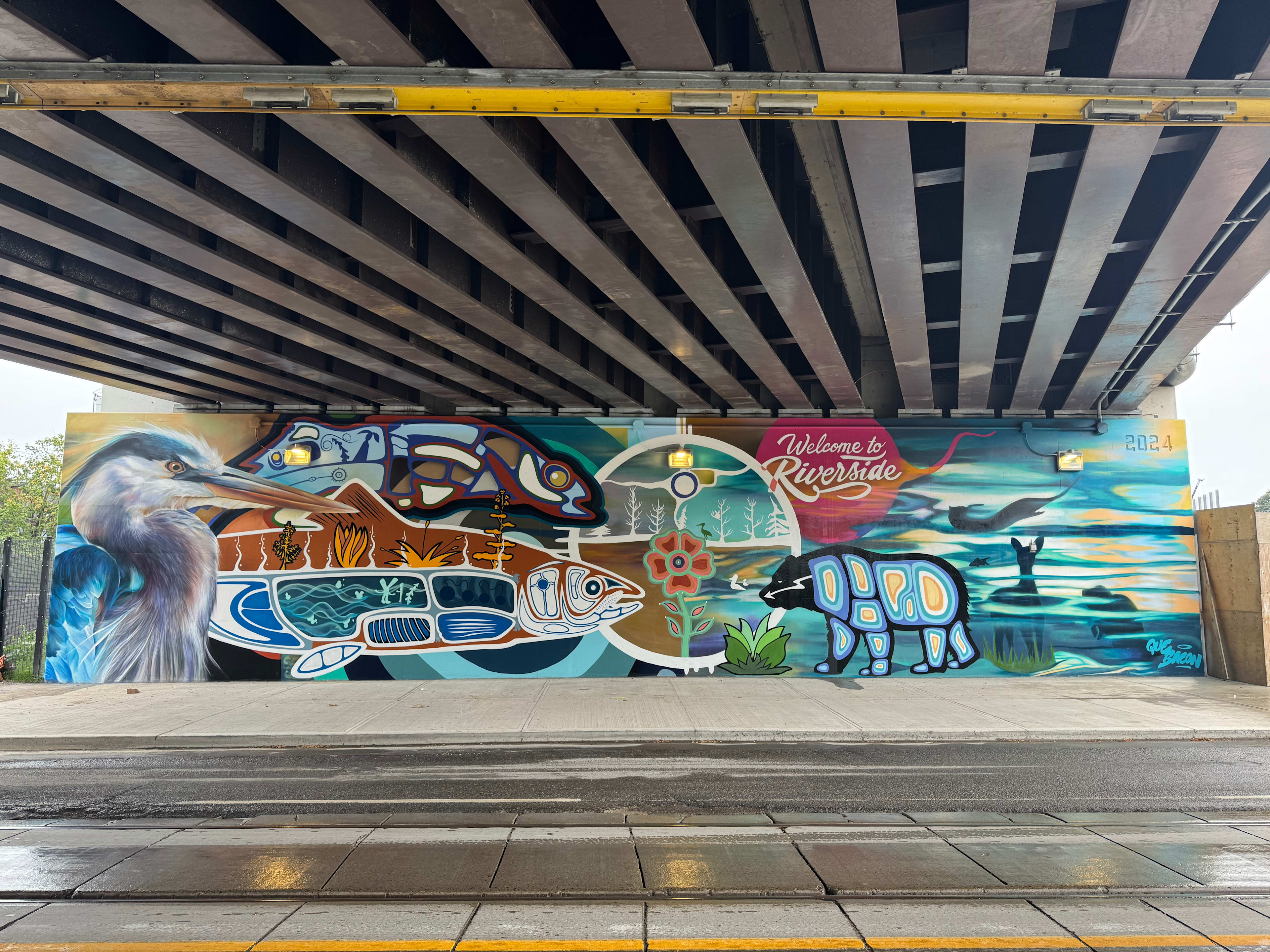
The “River of Life” mural underneath the rail bridge at Queen Street East and De Grassi Street. (Metrolinx image)
Beyond the bridges, early upgrades also included rebuilding retaining walls and installing noise barriers along a roughly 2.5-kilometre stretch of the corridor between Eastern and Jones avenues.
The retaining wall designs feature a mix of wave patterns and linear, shallow-grooved patterns, and the noise barriers use a transparent material. The retaining and noise wall designs were chosen in partnership with the community.
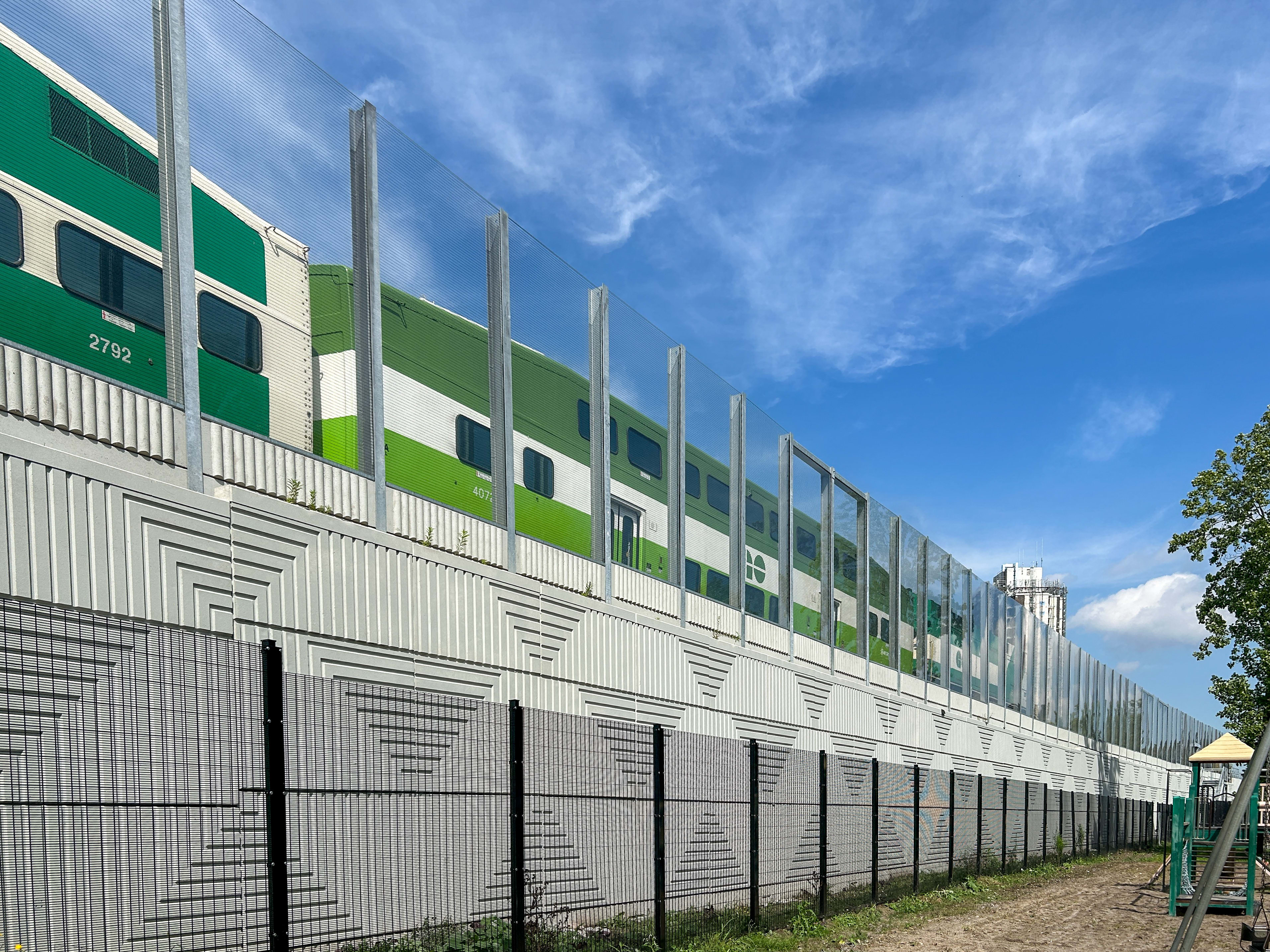
The new retaining wall features patterned tiles and transparent noise barriers. (Metrolinx image)
A design competition was held in 2021 for the retaining and noise walls, landscaping and the future plaza in front of Leslieville Station’s southern entrance.

Future south Leslieville Station entrance. Plaza design and landscaping to be determined in consultation with City of Toronto and community partners. (Metrolinx image)
Final landscaping and station plaza plans are being refined in consultation with the City of Toronto and the community.
East Harbour Transit Hub
The future East Harbour Transit Hub will be located immediately east of the Don Valley Parkway and south of Eastern Avenue. It will serve as a transit hub that will connect passengers with the Ontario Line, Lakeshore East and Stouffville GO lines, and TTC services.
Major construction started in June 2025, when work began on the foundations and retaining walls that will support the station and tracks. Since then, crews have started construction on the main station building, canopies and formwork – a temporary mold to shape poured concrete until it hardens – for the GO platforms.
Crews also recently lifted massive concrete girders into place. These horizontal supports will carry the Ontario Line over the future Broadview Avenue Extension.

Lifting girders – or horizontal supports – into place that will support the Ontario Line at the East Harbour Transit Hub. (Metrolinx image)
Next, we will shift GO trains onto the first two new permanent tracks in late November 2026. This will give crews the space they need to prepare the track bed between the Eastern Avenue bridge and Union Station area for the installation of even more tracks.
Leslieville Station
The new station at Queen Street East and De Grassi Street will serve the surrounding Riverside and Leslieville communities. Leslieville Station will be elevated above Queen Street, in line with the existing GO tracks.

Rendering of the future Leslieville Station at Queen Street East and De Grassi Street, looking east. (Metrolinx image)
Piling recently wrapped up, forming the foundations for the piers that will support the future station and tracks that will carry Ontario Line trains over Queen Street. Work is now underway on the piers.
Station construction is happening across two sites, north and south of Queen Street East on the west side of the tracks, where the future entrances will be located.

Piling at the north and south Leslieville Station construction sites, looking southwest. (Metrolinx image)
Gerrard Station
Gerrard Station will also be elevated and in line with the existing rail line, with entrances at ground level on the northeast and southwest corners of the Gerrard Street East and Carlaw Avenue intersection.

Rendering of the Gerrard Station, spanning the Gerrard and Carlaw intersection. (Metrolinx image)
Two construction sites are set up where the future entrances will be located, where piling for the future elevated tracks and station piers has been ongoing since June 2026.
In addition to piling, crews have been building new support walls to hold the existing rail line and surrounding soil safely in place during station work.

Crews insert anchors, called dowels, into concrete support walls at the north Gerrard Station site. (Metrolinx image)
Managing construction impacts (for people)
Sound barriers will replace the current plywood hoarding around the Leslieville and Gerrard sites in the future to reduce noise as station work progresses.
To keep pedestrians safely separated from construction, there will be times when we will need to temporarily divert or close sidewalks. Concrete barriers will separate any diverted sidewalks from traffic.
We will keep the community updated before these or any other changes, post signage in advance of detours or closures and update our interactive map with the latest details.
Managing construction impacts (for dogs!)
The Gerrard-Carlaw Parkette and its off-leash area for dogs is closed during station construction. To make sure the furry members of the community are taken care of during our work, we built a new, temporary dog park across the street at the southwest corner of Gerrard and Carlaw.

The new, temporary dog park at the southeast corner of Gerrard Street and Carlaw Avenue. (Metrolinx photo)
After construction wraps up, we will coordinate with the City of Toronto to restore the dog park in the Gerrard-Carlaw Parkette. Current plans to restore the dog park include features like landscaping, shady areas, a water fountain, pet-suitable turf and agility equipment.

Artistic rendering of the future Gerrard-Carlaw Parkette’s off-leash area for dogs. The design concept is subject to change. (Metrolinx image)
Looking ahead
At Leslieville and Gerrard stations, the next major construction phases will focus on building the piers, and pier caps, that will hold up the elevated tracks. After the piers will come guideway construction and then building the elevated stations and ground-level entrances.
As Ontario Line construction is completed, we’re also able to provide additional green space for the community throughout Riverside and Leslieville.
By rebuilding the retaining walls closer to the train tracks than before, we have freed up additional green space. This means that each of the four park spaces in the area – Jimmie Simpson Park, Bruce Mackey Park, McCleary Playground and the Gerrard-Carlaw Parkette – will be larger. In total, there will be nearly 3,000 square metres of added green space lining these parks.
For updates on the Ontario Line, follow @OntarioLine, sign up for email updates or connect with us in person at a community office.